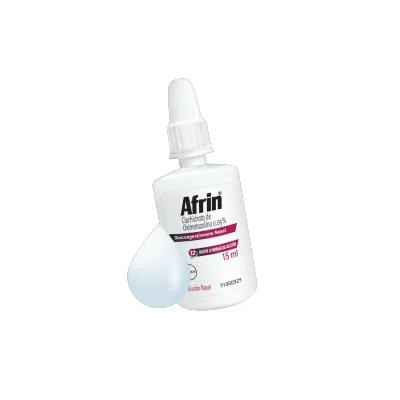
Afrin is a nasal decongestant spray for adults and children aged 6 years and over. Its active ingredient, oxymetazoline hydrochloride, provides short-term relief by narrowing swollen blood vessels in the nose.
Description
Afrin is a nasal decongestant spray containing oxymetazoline hydrochloride 0.05%. It is intended for adults and children aged 6 years and over with temporary nasal blockage from colds, hay fever, sinus congestion, or other upper-airway irritation. Oxymetazoline narrows swollen blood vessels inside the nose, helping air move more freely.
Composition
Afrin is supplied as a 15 ml nasal spray. Each millilitre contains oxymetazoline hydrochloride 0.05%. The dose is stated on the pack — follow the leaflet.
Oxymetazoline acts mainly on alpha-adrenergic receptors in the nasal lining. These receptors control the diameter of small blood vessels. When vessels contract, fluid leakage and tissue swelling fall, creating more space for airflow through the nostrils [1].
A blocked nose may alternate between nostrils during a cold. This normal nasal cycle can still occur after using Afrin and does not mean the spray has stopped working.
Dosage and usage
Afrin is used intranasally. The usual dose for adults and children aged 6 years and over is two or three sprays into each nostril every 10 to 12 hours, with a maximum of two doses within 24 hours.
Use Afrin for no more than three consecutive days.
Gently clear the nose before using the spray.
Keep the head upright rather than tilted far back.
Insert the nozzle just inside one nostril and aim slightly outward, away from the nasal septum.
Spray while breathing in gently through the nose.
Repeat in the other nostril.
Wipe the nozzle after use and keep it for one person only.
Do not exceed the recommended frequency. More sprays do not produce a better result and can raise the chance of rebound congestion, dryness, palpitations, or raised blood pressure.
Do not share a nasal spray, even within a household. The nozzle can transfer respiratory viruses and bacteria between users.
If a dose is missed, use Afrin only when congestion returns and the next permitted dosing interval has passed. Do not double the number of sprays.
The effect commonly begins within minutes. It may last for up to 12 hours. This duration can make Afrin useful before sleep or during travel.
The NHS advises limiting decongestant sprays because regular use beyond several days can make nasal congestion harder to settle [3].
How it works
Afrin works locally in the nasal passages rather than treating the virus, allergen, or inflammation that caused the congestion. Oxymetazoline constricts superficial blood vessels in the nasal mucosa, reducing swelling and the sensation of pressure.
Extended use can produce rebound congestion, also called rhinitis medicamentosa. The nasal lining becomes dependent on the decongestant effect, and blockage may return more strongly as the spray wears off. The National Library of Medicine describes this as a recognised risk with repeated topical vasoconstrictor use [2].
Indications
It is intended for adults and children aged 6 years and over with temporary nasal blockage from colds, hay fever, sinus congestion, or other upper-airway irritation.
It can also help when congestion makes it difficult to breathe through the nose. Afrin does not clear mucus from the chest, treat bacterial sinus infection, or replace allergy treatment where allergies are the underlying cause.
Comparison
Afrin is one option for short-term nasal blockage. The best approach depends on whether the main problem is a cold, allergy, thick mucus, sinus pressure, or repeated congestion.
Option
Main action
Suitable role
Oxymetazoline nasal spray
Shrinks swollen nasal blood vessels
Fast, short-term relief of marked blockage
Xylometazoline nasal spray
Shrinks swollen nasal blood vessels
Short-term decongestion with similar rebound risk
Saline spray or rinse
Moisturises and clears mucus
Frequent use for dryness, mucus, allergens, and mild congestion
Oxymetazoline and xylometazoline work in similar ways. Neither should be used continuously for longer than a few days. Saline products do not cause medication-related rebound congestion, though they may feel less powerful when the nose is severely swollen.
For persistent allergic rhinitis, clinicians often favour an intranasal corticosteroid because it reduces inflammation over time. It does not usually provide the near-immediate opening effect of Afrin. This difference matters: Afrin helps the swollen blood vessels; corticosteroid sprays target inflammatory activity.
Contraindications
Afrin is not for you if you have had an allergic reaction to oxymetazoline or another component of the spray.
Extra caution is needed with:
high blood pressure;
coronary heart disease, angina, or heart rhythm disorders;
chronic nasal dryness, recent nasal surgery, or damaged nasal tissue.
Oxymetazoline should not be combined with monoamine oxidase inhibitors, often called MAOIs, or used within 14 days of stopping them. This combination may increase the risk of a dangerous rise in blood pressure. Tricyclic antidepressants and some medicines used for Parkinson’s disease can also intensify sympathomimetic effects.
Pregnancy and breastfeeding require individual medical advice because nasal decongestants can affect blood vessels beyond the nose. The MHRA encourages careful medicine selection during pregnancy, including for products used without a prescription.
When this is not for you
Avoid using Afrin in children under 6 years old. Accidental overuse of topical decongestants can cause serious drowsiness, slowed breathing, blood-pressure changes, or heart-rate changes in young children.
If you have high blood pressure, heart disease, thyroid problems, diabetes, glaucoma, prostate-related difficulty passing urine, or damaged nasal tissue, ask a healthcare professional before using it.
Side effects
Most people tolerate short courses of Afrin without significant problems. Local effects are the most common and may include transient burning, stinging, dryness, sneezing, or irritation inside the nose.
Possible side effects include:
nasal dryness or crusting;
mild headache;
temporary sneezing after application;
a bitter taste if spray reaches the throat;
nervousness, tremor, or difficulty sleeping;
palpitations or a faster heartbeat;
increased blood pressure in susceptible people;
rebound congestion after prolonged or excessive use.
Systemic effects are uncommon when Afrin is used at the recommended dose, though oxymetazoline can be absorbed through the nasal lining. People with cardiovascular disease or sensitivity to stimulants may notice these effects more readily.
A bitter taste usually means the spray travelled toward the throat. Keeping the head upright and inhaling gently, rather than sharply, helps keep the dose in the nose.
Stop using Afrin and seek urgent medical assessment for chest pain, severe dizziness, fainting, facial swelling, wheezing, or a rapid irregular heartbeat. Persistent one-sided blockage, high fever, worsening facial pain, or symptoms lasting beyond a typical cold also need assessment because a decongestant will not treat every cause of nasal obstruction.
Common mistakes
The most frequent mistake is continuing Afrin after the third day because the nose feels blocked again. This often reflects rebound congestion rather than a need for more spray.
Other errors include:
using Afrin every few hours instead of respecting the 10-to-12-hour interval;
taking several extra sprays before bed;
aiming the nozzle toward the centre wall of the nose, which can increase irritation;
using a decongestant spray while taking an MAOI;
treating persistent facial pain or fever with Afrin alone;
using the spray to manage ongoing allergic rhinitis without addressing the allergy.
A second common issue is blaming the spray when a cold naturally fluctuates. Congestion often changes during the day due to lying down, dry indoor air, temperature changes, and mucus movement. Afrin can improve airflow, yet it cannot prevent the normal course of a viral cold.
If you have used Afrin for longer than three days and now feel more blocked between doses, reducing and stopping the spray may be uncomfortable for a short period. Saline irrigation can make that transition easier.
What doctors say
In clinical practice, doctors often see Afrin as a useful short-course option when nasal blockage is interfering with sleep, eating, or short-term daily comfort. The expected benefit is easier nasal breathing, not treatment of the underlying cold or allergy.
A clinician will usually focus on duration of use first. Three days is a practical boundary because it reduces the chance that temporary relief becomes rebound congestion. Doctors also look for patterns that suggest another condition, such as recurrent sinus symptoms, allergy-driven blockage, nasal polyps, or medication-related congestion.
The European Medicines Agency evaluates nasal medicines with attention to local tolerability and systemic exposure. For Afrin users, the practical message is simple: keep treatment short, use the smallest helpful amount, and avoid repeated dosing for weeks.
Frequently asked questions
How quickly does Afrin relieve a blocked nose?
Afrin can begin reducing nasal swelling within minutes because oxymetazoline acts directly on blood vessels in the nasal lining. Its effect may last up to 12 hours, which is why dosing is limited to twice a day. The FDA Drug Facts information for oxymetazoline sprays has long described temporary relief of nasal congestion with this type of medicine. The FDA label revision cited for Afrin was issued in 2016 [4].
How long can Afrin be used safely?
Afrin should be used for no more than three consecutive days. Longer use raises the likelihood of rebound congestion, where the nose blocks again as the effect wears off. NHS guidance published in 2023 advises that decongestant nasal sprays should not be used for more than about a week, while Afrin’s own oxymetazoline directions use a stricter three-day limit. The shorter limit is the sensible choice for avoiding dependency on nasal vasoconstriction.
Can Afrin be used for hay fever?
Afrin can temporarily ease a severely blocked nose during hay fever, but it does not control the allergic inflammation driving the symptoms. Sneezing, itchy eyes, watery discharge, and repeat seasonal congestion often respond better to allergy-focused treatment. The WHO-supported ARIA framework, first published in 2001, emphasises reducing allergen-driven inflammation rather than relying on repeated decongestant use. Reserve Afrin for short periods when nasal swelling is the main issue.
Can Afrin raise blood pressure?
Oxymetazoline is designed to work locally, yet some absorption can occur through the nasal lining. People with hypertension, coronary disease, hyperthyroidism, or an irregular heartbeat may be more sensitive to palpitations or blood-pressure changes. The MHRA’s medicine-safety approach in 2024 continues to place extra emphasis on checking sympathomimetic medicines in people with cardiovascular risk factors. Avoid exceeding the recommended dose or frequency.
Can Afrin be used with antidepressants?
Afrin must not be used with MAOI antidepressants or within 14 days after stopping an MAOI. These medicines can amplify the blood-pressure effects of sympathomimetic decongestants. Tricyclic antidepressants may also increase sensitivity to oxymetazoline in some people. The National Library of Medicine’s 2024 clinical monograph on oxymetazoline lists relevant interaction and cardiovascular precautions [5].
What should I do if Afrin causes rebound congestion?
Stop extending the course of Afrin, even if the blocked feeling is frustrating. Saline spray or nasal irrigation can reduce dryness and help clear mucus while the nasal lining settles. If severe congestion continues, especially with facial pain, fever, recurrent nosebleeds, or symptoms lasting more than 10 days, medical assessment is appropriate. The EMA’s 2014 guideline on the quality of nasal medicinal products recognises that local nasal tolerability is central to appropriate spray use.
Do you offer anonymous delivery?
Your order will be securely packed and shipped within 24 hours. This is exactly what your package will look like (images of an actual item sent). It has the size and look of a regular private letter (24x11x0.7 cm) and its contents cannot be seen.
I used Afrin during a bad cold because I could not sleep through my nose. It opened things quickly and I slept better. I stopped after the second night because I had read that using it too long can make congestion rebound.
5 Sept 2026
S
Sarah, 34
Bristol
Three days
Verified
Rating: 4 out of 5
The spray helped before a long train journey when my sinuses felt blocked. The first spray stung for a few seconds, then it settled. I found that breathing in too hard gave me a bitter taste.
16 Sept 2026
I
Imran, 46
Leeds
Four days
Verified
Rating: 3 out of 5
It worked well at first, but I carried on for an extra day and felt blocked again between doses. I stopped and used saline spray instead. The rebound feeling was annoying for a couple of days.
18 Aug 2026
H
Helen, 58
Sheffield
One short course
Verified
Rating: 4 out of 5
I was careful because I take tablets for blood pressure. I used the lowest amount that cleared my nose and did not take it near bedtime. It was useful for short-term relief, but I would not use it regularly.
24 Aug 2026
Sources
U.S. Food and Drug Administration (2016). Afrin Original Nasal Spray Drug Facts Label.
National Library of Medicine (2024). Oxymetazoline.
NHS (2023). Decongestants.
U.S. Food and Drug Administration (2022). OTC Monograph M012: Cold, Cough, Allergy, Bronchodilator, and Antiasthmatic Drug Products.
National Library of Medicine (2024). DailyMed: Oxymetazoline Hydrochloride Nasal Spray Label.