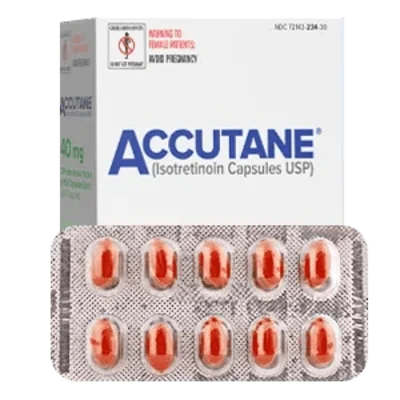
Accutane is an oral isotretinoin medicine for people with severe or treatment-resistant acne. By reducing sebaceous gland activity, it helps limit blocked pores and inflammatory breakouts.
Description
Accutane is a prescription oral retinoid containing isotretinoin for severe, nodular, cystic, or treatment-resistant acne. It is used when topical treatments or antibiotics have not achieved adequate control. Isotretinoin reduces sebaceous gland activity, helping to limit blocked pores and inflammatory breakouts.
Composition
Accutane contains isotretinoin in capsule form. Isotretinoin is a retinoid, meaning it is chemically related to vitamin A but used at therapeutic doses under specialist supervision. It is prescribed for severe acne that risks scarring, causes painful deep lesions, or persists despite other treatment approaches.
The capsule is swallowed whole. Do not open, crush, or chew it, since its contents can irritate the mouth and should not contact skin unnecessarily.
Take Accutane with a meal containing some fat. Isotretinoin absorption is higher with food, so taking it on an empty stomach may reduce the amount absorbed.
The MHRA treats oral isotretinoin as a medicine requiring strict risk management because of pregnancy risks and possible psychiatric effects [1].
Dosage and usage
Dose: Take the prescribed isotretinoin capsule strength in mg exactly as stated on the prescription or pack; do not select the dose yourself.
Frequency: Take the prescribed number of capsules at the prescribed frequency each day; the exact schedule is stated on the pack or leaflet.
Timing: Take the capsules at the prescribed time, with food when directed by the leaflet. Do not take two doses together if one is missed.
Duration: Treatment commonly lasts about 4–6 months and is adjusted to body weight, response, tolerability, and the planned cumulative dose.
Route and form: Take Accutane by mouth as capsules. It is a systemic treatment, not a topical product.
Monitoring: Attend the required monitoring appointments, including liver-enzyme and blood-lipid checks. Pregnancy must be excluded and reliably prevented before, during, and after treatment; follow the prescriber’s contraception and pregnancy-testing instructions.
How it works
Isotretinoin is a retinoid related to vitamin A that acts on the biological processes driving acne. It reduces sebaceous gland activity, sebum production, blocked pores, and inflammation, helping to limit inflammatory breakouts.
Indications
Accutane is used for severe nodular acne, cystic acne, painful cystic acne, and persistent acne that has not responded to standard therapy. Deep lesions can leave permanent scars, even when the visible inflammation later settles. Oral isotretinoin can also be considered for moderate to severe acne when it repeatedly relapses or causes substantial psychological distress.
It is not usually the first approach for mild acne with occasional spots. Mild to moderate acne often responds to topical retinoids, benzoyl peroxide, topical antimicrobials, or limited antibiotic courses. Adult-onset acne and hormonal acne may also need an assessment of hormonal patterns, menstrual symptoms, and medicine history.
A full course can produce long-lasting remission. Relapse still occurs in some people.
Comparison
Acne treatment choice depends on severity, scarring risk, skin sensitivity, hormonal pattern, and previous response. Accutane is systemic treatment for severe disease; topical medicines work mainly at the skin surface.
Treatment approach
Main action
Typical role
Accutane with isotretinoin
Reduces sebum production, blocked pores, and inflammation throughout the body
Severe, nodular, cystic, or resistant acne
Topical retinoids such as tretinoin or adapalene
Normalise skin-cell shedding inside pores
Mild to moderate comedonal acne and maintenance
Hormonal therapy such as spironolactone
Reduces androgen-driven oil production
Selected adults with hormonal acne
Benzoyl peroxide reduces acne-causing bacterial load and inflammation, often alongside a topical retinoid. Antibiotics may help inflammatory acne for limited periods, though they do not shrink sebaceous glands in the way isotretinoin does. Retinol is a cosmetic-strength vitamin A derivative and is much less potent than prescription retinoids.
Spironolactone can suit some adults with hormonal acne, especially where breakouts cluster around the jawline and flare cyclically. Acitretin is another oral retinoid, but it is primarily used for psoriasis rather than routine acne treatment.
Contraindications
Accutane must also be avoided with vitamin A supplements or other oral retinoids, as combined exposure raises toxicity risk. People with significant liver disease, persistently high blood lipids, heavy alcohol intake, or a history of serious depression require careful specialist assessment before treatment.
Avoid donating blood during treatment and for one month after the final dose. Donated blood could be given to someone who is pregnant.
Breastfeeding is incompatible with Accutane treatment because isotretinoin may pass into breast milk.
When this is not for you
This medication is NOT for you if you are pregnant, may be pregnant without reliable pregnancy prevention, are breastfeeding, have an allergy to isotretinoin or capsule ingredients, or are using a tetracycline antibiotic.
Side effects
Dryness is expected with isotretinoin. Chapped lips, dry facial skin, nosebleeds from dry nasal passages, dry eyes, and increased sun sensitivity are among the most frequent effects. Lip dryness can become noticeable within days, often before acne improvement is visible.
A bland lip balm and fragrance-free moisturiser are usually more useful than repeatedly changing acne products. Contact lenses may feel uncomfortable because tear production can decrease. Some people need glasses more often during treatment.
Keep lip balm in the same place as the capsules. Applying it before lips crack is much easier than treating painful fissures later.
Less common but clinically significant effects include raised triglycerides, changes in liver enzymes, muscle or joint pain, persistent headache, visual disturbance, and severe abdominal pain. Mood changes, depression, anxiety, aggression, and suicidal thoughts have been reported during isotretinoin treatment. A direct cause is difficult to prove because severe acne itself can affect mental health, yet new psychiatric symptoms must never be ignored.
The EMA advises monitoring for psychiatric symptoms, and the U.S. Food and Drug Administration also highlights the medicine’s major pregnancy-prevention requirements [3]. Severe headache with nausea, vomiting, or altered vision needs urgent assessment because it can signal raised pressure inside the skull.
Common mistakes
The mistakes that most often disrupt an Accutane course include:
Taking capsules without food, which can reduce absorption.
Doubling the next dose after forgetting one.
Using vitamin A supplements at the same time.
Starting doxycycline, lymecycline, or another tetracycline antibiotic without prescriber approval.
Picking or squeezing inflamed lesions during the early flare.
Using harsh scrubs, strong exfoliating acids, or abrasive cleansing brushes on retinoid-dry skin.
Missing blood tests because the skin appears to be improving.
NICE acne guidance describes oral isotretinoin as a specialist option for severe acne resistant to adequate standard treatment [2].
What doctors say
In clinical practice, dermatologists focus less on a perfect week-by-week appearance and more on steady lesion reduction over the full course. New inflammatory spots may continue during the first month. By months two and three, many patients see fewer deep lesions and less oiliness.
Doctors also assess whether dryness is manageable, whether blood results remain acceptable, and whether mood has changed. A patient who feels low, unusually irritable, withdrawn, or overwhelmed needs a prompt clinical review. The goal is acne clearance without pushing through severe adverse effects.
Frequently asked questions
How long does Accutane take to improve acne?
Early improvement often begins after six to eight weeks, while deeper clearance usually develops across several months. A temporary flare can occur in the first month as existing blocked pores emerge. NICE guidance from 2023 supports specialist-led oral isotretinoin for severe acne after adequate standard treatment has failed. Visible progress is judged over the course, not after a few capsules. Scheduled reviews help clinicians assess progress and tolerability.
Can Accutane cause permanent side effects?
Most dryness, skin sensitivity, and muscle discomfort improve after treatment ends. Some effects, such as persistent visual changes, severe mood symptoms, or significant lipid abnormalities, need medical assessment rather than waiting for the course to finish. The EMA’s 2018 isotretinoin safety review highlights the need to report psychiatric symptoms and vision-related concerns promptly. Permanent effects are uncommon, but severe symptoms warrant action.
Can alcohol be used while taking Accutane?
Alcohol can raise triglycerides and add strain to the liver, which are the same areas monitored during isotretinoin therapy. The MHRA’s 2023 safety approach requires prescribers to consider liver and lipid risks throughout treatment. Avoiding alcohol is the lowest-risk choice, especially if blood tests have shown raised triglycerides or liver enzymes. Do not use alcohol to manage anxiety or low mood during treatment.
What happens after a missed Accutane dose?
Take the next scheduled dose with food and leave the missed dose unreplaced. Taking extra capsules does not restore the intended cumulative schedule and increases exposure to adverse effects. The British Association of Dermatologists, in its 2023 isotretinoin patient guidance, advises following the prescribed schedule rather than doubling doses. Repeated missed doses should be discussed at the next treatment review.
Can Accutane be taken with doxycycline or lymecycline?
No. Tetracycline antibiotics, including doxycycline and lymecycline, must not be combined with isotretinoin because both can increase the risk of intracranial hypertension. The EMA’s 2018 isotretinoin product information includes this interaction. Tell the prescriber about every medicine, supplement, and acne treatment before starting a course.
Is Accutane suitable for teenagers?
Accutane can be prescribed to adolescents with severe acne when specialist assessment shows that the expected benefit outweighs the risks. Age does not remove the need for blood monitoring, pregnancy prevention where relevant, or mental-health review. The MHRA’s 2023 safety measures apply to children and young people as well as adults. Parents or carers can help younger patients maintain the dosing, moisturising, and appointment routine.
Do you offer anonymous delivery?
Your order will be securely packed and shipped within 24 hours. This is exactly what your package will look like (images of an actual item sent). It has the size and look of a regular private letter (24x11x0.7 cm) and its contents cannot be seen.
Many people experience prolonged acne remission after a complete isotretinoin course. Reduced skin oiliness may continue for months, although normal sebum production gradually returns. A minority need another course if severe acne returns.
Skin can remain sensitive for a while after treatment. Continue daily broad-spectrum sun protection, as burning can occur more easily during the course and recovery period. Avoid waxing while taking isotretinoin and for six months afterwards because fragile skin may lift or tear.
Pause facial waxing, dermabrasion, and aggressive resurfacing treatments during Accutane therapy. Tell any clinician providing a cosmetic procedure that you use or recently used isotretinoin.
Scarring does not disappear at the same speed as active acne. Dermatologists often wait until acne has been stable before considering scar-directed procedures.
Accutane: Reviews and Experiences
M
Maya, 24
Manchester
Five months
Verified
Rating: 4.5 out of 5
My lips became dry in the first week, so I started carrying balm everywhere. My cysts looked angrier during week three, then gradually flattened. By the fourth month I was no longer waking up with painful spots along my jaw.
27 Aug 2026
T
Tom, 19
Leeds
Four months
Verified
Rating: 4.5 out of 5
I had tried gels and antibiotics before. The difference for me was less oil on my forehead after about six weeks. I did get dry eyes when studying late, so I switched from contact lenses to glasses on long days.
4 Sept 2026
H
Hannah, 31
Bristol
Six weeks
Verified
Rating: 3.5 out of 5
The early breakout was worse than I expected and I felt discouraged. My dermatologist reviewed my skincare and told me to stop exfoliating acids. The routine became easier once I used a plain moisturiser and stopped trying new products.
11 Sept 2026
D
Daniel, 27
Glasgow
Three months
Verified
Rating: 3.5 out of 5
The acne improved, but muscle aches after football were annoying. My blood tests stayed fine, and reducing intense training for a few weeks helped. I was glad I mentioned it instead of assuming it was unrelated.
24 Sept 2026
Sources
MHRA (2023). Isotretinoin (Roaccutane▼): new safety measures, including additional oversight of the initiation of treatment for patients under 18 years of age.
NICE (2023). Acne vulgaris: management (NG198).
EMA (2018). Isotretinoin: new safety measures for pregnancy prevention and possible psychiatric disorders.