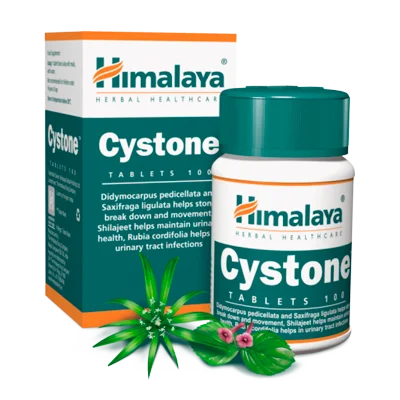
Cystone is a multi-herbal oral tablet for adults seeking adjunctive support with urinary symptoms or urinary crystals. Its botanical approach supports urine flow and may help reduce conditions that favour crystal aggregation.
Description
Cystone is an oral herbal tablet formulation used to support urinary tract comfort and kidney stone management. It is intended for adults seeking adjunctive support with recurrent urinary symptoms or urinary crystals. Its botanical approach is designed to support urine flow and reduce conditions that can favour crystal aggregation.
Composition
Cystone is an oral multi-herbal tablet formulation for adults. The exact botanical ingredients, quantities, and other composition details are stated on the product pack and should be checked before use.
Dosage and usage
Cystone tablets are taken orally with water. Regular timing can make a herbal routine easier to maintain, though the correct individual schedule should follow the product directions provided on this page or a clinician’s recommendation.
Use practical measures alongside tablets:
Drink fluids steadily through the day unless a clinician has advised a fluid restriction.
Avoid intentionally holding urine for long periods.
Maintain normal meals rather than following extreme low-calcium diets.
Record recurrent stone episodes, urine infections, and prescribed medicines.
Continue prescribed stone-prevention treatment unless the prescriber changes it.
Missing a scheduled dose does not require doubling the next dose. Resume the usual routine at the next planned time.
For stone prevention, spreading fluids across the day is more useful than drinking a large volume late at night. Very dark urine after several hours without fluids is a practical sign that intake may be low.
How it works
Cystone is intended to support the urinary environment through a multi-herbal approach. The proposed actions include supporting normal urine flow, reducing crystal aggregation, and easing mild urinary discomfort.
Stone formation is a stepwise process. Minerals become concentrated in urine, tiny crystals form, then crystals can grow and attach to surfaces within the urinary tract. Adequate fluid intake lowers urinary concentration, while medical prevention depends on the stone’s chemical type.
The anti-lithiasis effect described for herbal urinary products is best understood as supportive rather than stone-dissolving treatment. A tablet cannot reliably dissolve all established stones. Larger stones, obstructing stones, and stones causing repeated severe colic may need imaging and procedural treatment.
Indications
Cystone is used as herbal support in several urinary-health situations:
Recurrent urinary crystal formation or crystalluria.
Mild urinary discomfort associated with concentrated urine.
Supportive care for people with a history of kidney stones.
Comfort during mild bladder irritation without systemic symptoms.
Crystalluria means crystals are found in urine. It does not always mean that a person has a stone, and it does not automatically require treatment. The clinical context matters: urine pH, infection markers, stone history, diet, medicines, and imaging results can change the interpretation.
Cystone should not be relied on to treat acute cystitis with fever, flank pain, nausea, or feeling unwell. Those features can indicate infection beyond the bladder. The WHO recognises that traditional herbal products are widely used, while also stressing the need for appropriate diagnosis and pharmacovigilance when symptoms could represent a serious condition [2].
A common misconception is that all urinary discomfort is a urinary tract infection. Urinary discomfort can also result from stones, irritation, dehydration, or other bladder conditions. Repeated antibiotic use without confirming infection can cause avoidable side effects and may not address the actual cause.
Comparison
Cystone has a broader botanical focus than single-ingredient urinary supplements. Each approach has a different role, and none replaces investigation for recurrent stones or suspected infection.
Approach
Main focus
Key limitation
Cystone herbal tablets
Multi-herbal urinary comfort and stone-support routine
Evidence for specific stone types is limited
Cranberry-based supplements
Reducing bacterial adherence in recurrent uncomplicated cystitis
Does not treat an established infection
D-mannose supplements
Urinary support aimed at recurrent uncomplicated cystitis
Not a treatment for kidney stones or feverish infection
Cranberry and D-mannose are mainly discussed in the context of recurrent uncomplicated lower urinary tract infections. Cystone is more often selected where urinary crystals, stone history, and urinary comfort are also concerns.
Prescription prevention for recurrent stones is different again. A clinician may use citrate therapy, thiazide-type treatment, allopurinol, or other targeted therapy after identifying the stone type and metabolic cause. That route has stronger evidence for defined stone disorders, but it also needs monitoring and is not interchangeable with herbal support.
Contraindications
Cystone is not for you if you have had an allergic reaction to any of its constituents.
Fever, chills, flank pain, or vomiting with urinary symptoms.
Known severe kidney impairment or a history of urinary obstruction.
Inability to pass urine or markedly reduced urine output.
Persistent visible blood in urine.
A known large stone, repeated renal colic, or a single functioning kidney.
Pregnancy or breastfeeding unless its use has been specifically assessed by a clinician.
A child or adolescent requiring urinary stone or infection treatment.
People taking regular medicines should consider possible herb–medicine interactions before starting any multi-herbal product. This is relevant for anticoagulants, diabetes medicines, blood-pressure treatments, diuretics, lithium, and medicines cleared through the kidneys. The MHRA advises reporting suspected adverse effects from herbal medicines through its Yellow Card scheme, including reactions that develop after a product has been used for several days [3].
When this is not for you
Avoid self-managing with Cystone alone if you have fever, chills, flank pain, or vomiting with urinary symptoms. Do not use it as your only approach if you cannot pass urine, have persistent visible blood in urine, a known large stone, repeated renal colic, or a single functioning kidney. Pregnancy, breastfeeding, and urinary stone or infection treatment in children or adolescents require specific clinical assessment.
Side effects
Herbal tablets are often well tolerated, though they can still cause side effects. The most plausible problems are mild stomach upset, nausea, loose stools, or a sensitivity reaction to one of the botanical constituents.
Stop using Cystone and seek urgent help if swelling of the lips or face, wheezing, widespread rash, fainting, or severe vomiting occurs. These symptoms can signal a serious allergic reaction.
Urinary symptoms can also change for reasons unrelated to the tablets. Worsening pain, fever, visible blood in urine, inability to pass urine, or repeated vomiting needs clinical assessment rather than increasing the tablet intake.
Do not judge urinary progress by urine colour alone. B-complex vitamins, foods such as beetroot, dehydration, and some medicines can change colour without proving that a stone has passed.
Common mistakes
Taking extra tablets during severe colic instead of arranging assessment.
Assuming burning urination always means a bacterial infection.
Drinking very little through the day, then trying to compensate with a large evening intake.
Stopping prescribed citrate or other stone-prevention medicine without medical direction.
Ignoring visible blood in urine because it occurred during a previous stone episode.
Using leftover antibiotics for new urinary symptoms.
One detail patients often miss is that a stone can move and still cause obstruction. Pain that suddenly settles does not prove that the urinary tract is clear.
What doctors say
In clinical practice, urinary symptoms are assessed by pattern before treatment is chosen. Burning with frequency may point towards lower urinary infection, while severe wave-like flank pain can suggest ureteric stone movement. Fever changes the picture completely.
Doctors often encourage people with recurrent stones to bring prior scan reports or passed-stone analysis to an appointment. A report saying kidney stone is less useful than knowing the size, location, and chemical composition.
Cystone can be a reasonable adjunct for adults with mild recurring urinary discomfort who have no red-flag symptoms. Its limitation is that it does not replace antibiotics for proven bacterial infection or procedures for an obstructing stone.
Frequently asked questions
Can Cystone prevent kidney stones?
Cystone may support urinary health in people concerned about crystal formation, but it cannot guarantee prevention of kidney stones. Stone prevention depends on the stone type, urine chemistry, daily fluid intake, diet, and prescribed treatment where needed. The European Association of Urology’s 2024 urolithiasis guidance focuses on identifying these individual risk factors before choosing prevention measures. A history of recurrent stones should prompt cause-specific assessment.
Can Cystone treat a urinary tract infection?
Cystone is not an antibiotic and should not be used as treatment for a confirmed bacterial urinary tract infection. It may be used for supportive urinary comfort, but fever, flank pain, vomiting, or worsening symptoms require prompt clinical assessment. NICE’s 2018 urinary tract infection guidance supports treatment decisions based on symptom severity and risk of complications. Urine testing can be useful when infections recur or symptoms do not settle.
Is Cystone useful for crystalluria?
Crystalluria means that crystals are present in urine, and Cystone may be used as supportive care in this setting. Crystals can occur after dehydration and may also reflect a tendency towards stone formation. The WHO’s 2019 report on traditional medicine recognises the role of herbal products in supportive care, while diagnosis remains essential when symptoms persist. Fluid intake and urine assessment remain central to managing repeated crystalluria.
Can Cystone be used every day?
Daily use may be considered as part of a urinary support routine when there are no contraindications or red-flag symptoms. It should not delay investigation of recurrent pain, recurrent infection, blood in the urine, or known kidney disease. The MHRA’s 2014 herbal medicine safety guidance supports attention to adverse effects and possible interactions during ongoing use. Long-term benefit is more likely when hydration and stone-specific prevention are addressed too.
Does Cystone relieve burning urination?
Cystone may support comfort when mild urinary irritation is present, but burning has several possible causes. Bacterial cystitis, a passing stone, dehydration, vaginal irritation, and sexually transmitted infections can all produce similar symptoms. NICE guidance from 2018 advises clinical assessment when symptoms are severe, recurrent, or accompanied by systemic illness. Burning with fever or flank pain needs urgent evaluation.
Can Cystone be combined with prescription stone treatment?
Cystone may be used alongside prescribed management only when the full medicine list has been considered. Prescription stone prevention can include treatments that alter urine pH or mineral handling, so the cause of the stones should guide the plan. The EMA’s 2020 guidance on herbal medicinal products highlights the importance of assessing quality, safety, and interactions for herbal preparations. Do not stop prescribed treatment solely because symptoms improve.
Do you offer anonymous delivery?
Your order will be securely packed and shipped within 24 hours. This is exactly what your package will look like (images of an actual item sent). It has the size and look of a regular private letter (24x11x0.7 cm) and its contents cannot be seen.
Long-term urinary wellness depends more on the underlying cause than on any single tablet. People with one small stone after dehydration may need different support from those with recurrent calcium oxalate stones, gout-related uric-acid stones, recurrent infection stones, or anatomical urinary tract problems.
A repeated pattern deserves investigation. Urine testing, stone analysis, blood tests, and imaging can identify factors that simple symptom-based care misses. This is where Cystone may fit as an adjunct to a structured prevention plan rather than the plan itself.
The drawback of long-term unsupervised use is delayed diagnosis. Symptoms that seem familiar can sometimes reflect infection, obstruction, prostate enlargement, or bladder disease.
Lifestyle and daily habits
New one-sided back pain with fever or chills needs urgent medical assessment. These symptoms can indicate an obstructed and infected urinary tract, which requires prompt treatment.
Keep a brief symptom note for recurring episodes: pain location, visible blood, fever, urine frequency, and fluid intake. Those details are often more useful in a consultation than a vague report of kidney discomfort.
The European Association of Urology recommends identifying the stone type and metabolic risk where stones recur, rather than treating every episode in the same way [1].
Cystone: Reviews and Experiences
M
Maya, 41
Bristol
Six weeks
Verified
Rating: 4.5 out of 5
I used Cystone after a previous small stone and focused more on drinking water at work. I did not have the same bladder irritation by the end of the month, although I also changed my habit of skipping fluids during meetings.
24 Aug 2026
D
Daniel, 54
Leeds
Two months
Verified
Rating: 3.5 out of 5
I had recurrent gritty urine sensations after long days outdoors. The tablets fitted easily into my routine, but the useful change was carrying a water bottle and getting a urine test when the burning returned.
7 Sept 2026
S
Saira, 36
Birmingham
Three weeks
Verified
Rating: 2 out of 5
I expected it to stop sharp flank pain quickly, and it did not. The pain became intense overnight and a scan later showed a stone that needed separate treatment. I would not use tablets alone for that type of pain again.
14 Sept 2026
H
Helen, 48
Manchester
Five weeks
Verified
Rating: 4 out of 5
I tolerated it well and felt less urinary discomfort after the first couple of weeks. I liked using it as part of prevention, although I still arranged testing because I have had more than one infection before.
22 Sept 2026
Sources
European Association of Urology (2024). EAU Guidelines on Urolithiasis
World Health Organization (2019). WHO global report on traditional and complementary medicine 2019
Medicines and Healthcare products Regulatory Agency (2014). Herbal medicines: regulation and safety